Balen Nominated U.S. Ambassador Nominee Chiran Jung Thapa, who is he?
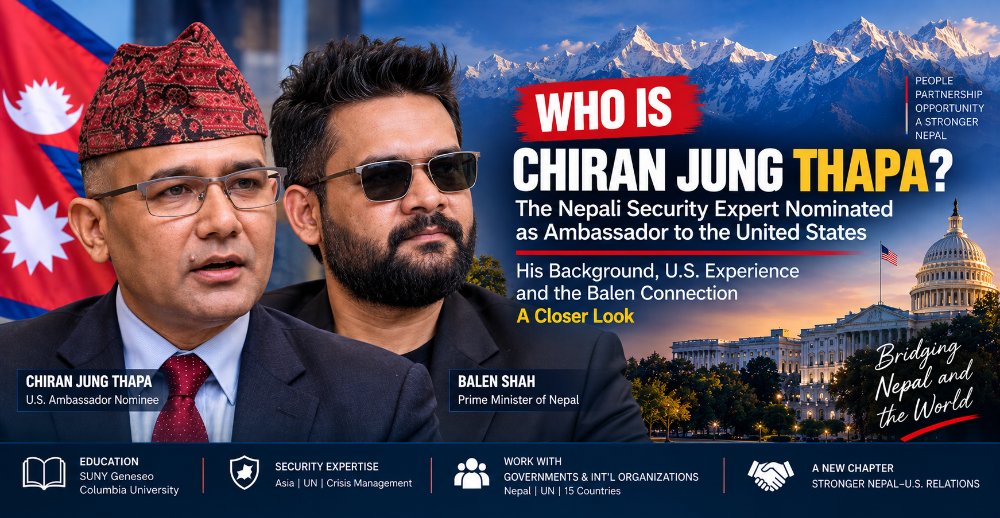
Chiran Jung Thapa is a Nepali national-security and international-affairs specialist recommended by Nepal’s Cabinet on September 18, 2026, to serve as Nepal’s ambassador to the United States. He must still complete the required approval and appointment process before formally becoming ambassador. Thapa is no stranger to the United States. He studied in Geneseo and New York City, later worked for several years in New York's international-diplomatic community, and received additional security training at Harvard and in Hawaii. His documented U.S. experience includes SUNY Geneseo, Columbia University and work connected to the United Nations in New York—giving Nepal's proposed ambassador an unusually extensive firsthand connection to the country where he may soon represent Nepal. Thapa has a strong security and international-relations background rather than a traditional career-diplomat profile. He studied International Relations at SUNY Geneseo and earned a master’s from Columbia University’s SIPA. His career has included senior security roles with Oxfam, Saferworld and The Asia Foundation, as well as earlier work involving the Nepal and Singapore missions to the United Nations in New York. His expertise includes national security, intelligence, counterterrorism, crisis management and civil-military relations. He has advised Nepal’s Ministry of Defence, National Security Council, Nepal Army and Nepal Police, lectured at Nepalese security institutions, and reportedly helped develop the Nepal Army’s first civil-military relations curriculum. Among the more unusual parts of his résumé, Thapa reportedly became the first non-uniformed Nepali to complete Harvard Kennedy School’s Leadership in Homeland Security program, has twice received the Nepal Army Chief of Army Staff Commendation, and represented Nepal as a keynote speaker at the Indian Army’s inaugural Chanakya Defence Dialogue in 2023. He has also publicly discussed sensitive regional issues, including India-Nepal relations, terrorism and Nepal’s preparedness for evacuating citizens from international conflict zones. Thapa's selection also has a Balen–Rabi connection—but primarily through the appointment process. Prime Minister Balen Shah and RSP chair Rabi Lamichhane were involved in consultations over the ambassadorial slate before it went to Cabinet. Public reporting does not yet establish that Thapa himself is personally or politically aligned with either leader. In short: Thapa's nomination is notable because Nepal would be sending to Washington someone whose career has been centered heavily on security, defense, crisis management and international affairs, combined with significant educational and professional experience in the United States.
adminMember since 2010 · Sep 19, 2026 8:25 AM · 1,642 views
-
 by NepalUnfiltered · Sep 20, 2026 1:26 PM · 231 views
 -
 by NepalUnfiltered · Sep 20, 2026 7:57 AM · 133 views
 -
 by NepalUnfiltered · Sep 19, 2026 11:31 PM · 179 views
 -
 by NepalUnfiltered · Sep 20, 2026 1:01 PM · 70 views
 -
 by NepalUnfiltered · Sep 20, 2026 12:37 PM · 581 views
-
Greenbrier Mall, Chesapeake, VA · Sep 14, 2026 1:39 PM
-
Woburn, MA, United States · Sep 12, 2026 6:28 PM
-
Somerville, MA, United States · Sep 9, 2026 2:23 PM
-
Boston, MA, United States · Sep 8, 2026 8:10 PM
-
Arlington, MA, United States · Sep 7, 2026 6:50 PM
-
Somerville, MA, United States · Sep 19, 2026 10:20 AM
-
Somerville, MA, United States · Sep 18, 2026 11:47 PM
-
Beautiful Room for Rent USD 600.00Manassas, VA, United States · Sep 18, 2026 11:22 PM
-
Walkout Basement rent in manassas $1,300.00Manassas, VA, United States · Sep 18, 2026 8:11 PM
-
Queens, NY, United States · Sep 18, 2026 6:15 PM